
Home, uninterrupted
Can a portable station really power your home?
What whole-home backup actually means, why essentials last longer, and how to put a realistic number on your running time.
4 min read
Takeaway. Plan for the loads you need, not the size of your house. Running a few essential appliances and backing up every circuit are very different jobs.
Start with the things that matter most
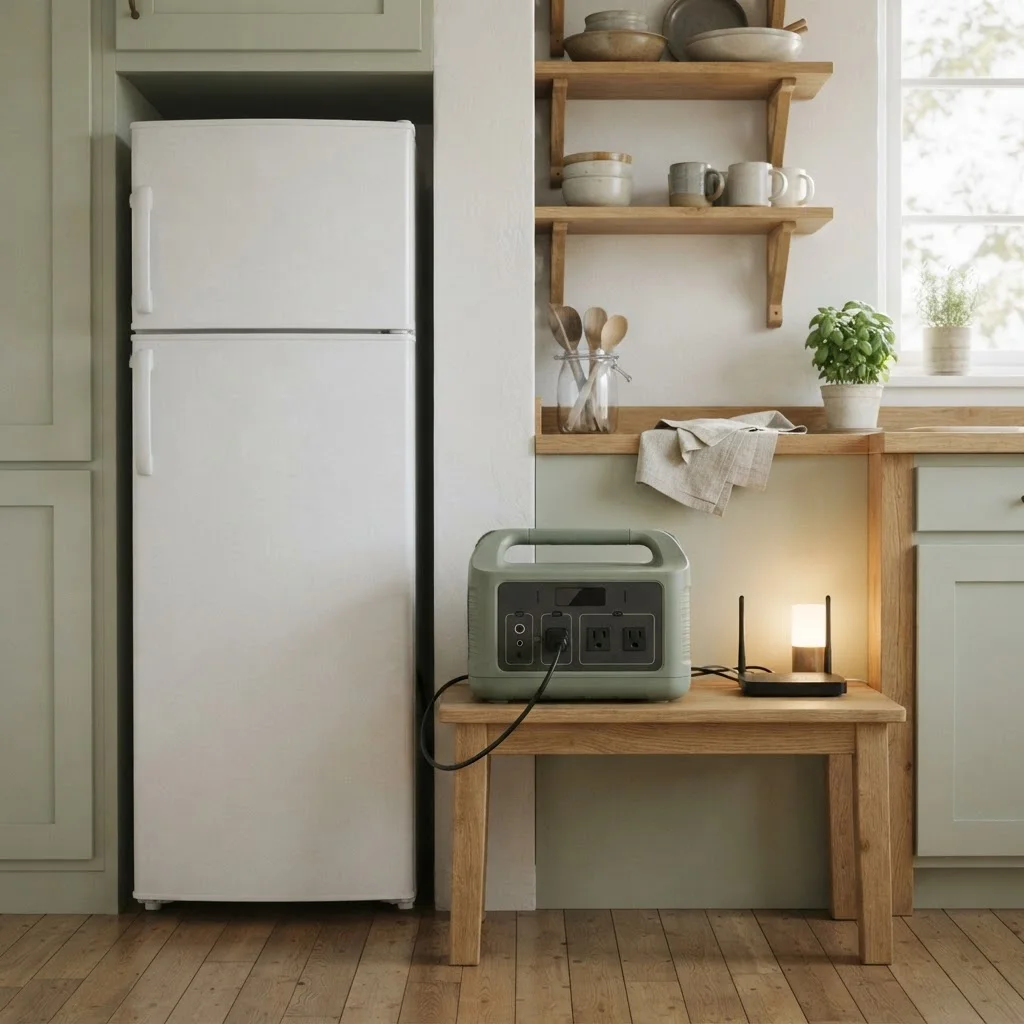
During an outage, a refrigerator, a few lights and a charged phone can make the biggest difference. A router is useful too, although keeping it powered does not guarantee that your internet provider’s network will remain online. Write a short essential-load list before looking at battery sizes.
Then make a second list of things you can temporarily do without: an electric oven, space heater, tumble dryer or central air conditioning. These high-power loads can change the answer dramatically. The goal is not to make an outage invisible at any cost; it is to keep the parts of your day that matter most working.
Put a realistic number on the hours
Here is an illustration, not a product test. Suppose a 2,000 Wh battery delivers 85% of its nameplate energy to your loads after losses and reserve. That leaves 1,700 Wh. At an average combined draw of 150 W, the estimated runtime is about 11.3 hours. At a steady 1,000 W, the same battery would last about 1.7 hours.
A 10 kWh system under those same 85% and 1,000 W assumptions would last about 8.5 hours. These examples assume a full battery, no incoming charge and equipment that the inverter can actually run. Temperature, age, cutoff settings, standby draw and variable loads can move the result outside the estimate.
The most useful measurement is energy over time. The Department of Energy recommends usage monitors, particularly for appliances such as refrigerators that cycle on and off. A fridge’s nameplate power is not necessarily its 24-hour average. Measure a representative day and include other devices you intend to run alongside it.
A whole house is a much bigger energy budget
For perspective, EIA reported that the average U.S. residential electricity customer purchased 10,791 kWh from the grid in 2022. Spread over the year, that is approximately 29.6 kWh per day. This is a dated national purchasing statistic, not the total consumption of every home and not a recommendation for battery size.
Your own seasonal bills and circuit measurements are more useful. A compact home with gas heating may have a very different backup requirement from a similar-sized all-electric home. A single battery’s watt-hour figure cannot tell you whether it will run your heat pump, well pump or cooker, even if the arithmetic suggests enough energy.

Capacity is only half of a safe setup
There are two separate questions: how much energy you can store, and how much power the station can supply at once. Check continuous output, startup surge, output voltage and the appliance’s requirements. In the U.S., a 120 V-only station is not a substitute for a 240 V supply to a larger appliance.
For a plug-in appliance, use a station and correctly rated cord approved for that application. Connecting backup power to fixed home circuits is a different task: it needs compatible, code-compliant transfer equipment and a qualified electrician. Never feed a station’s output into an ordinary wall outlet. Backfeeding can energize utility wiring and endanger people working on it.
Make the plan before the lights go out
Test the real appliances together while mains power is available, check their startup behavior, and make sure everyone in the household knows the safe connection procedure. Keep the station accessible and follow the manufacturer’s storage and charge-maintenance instructions. If life-sustaining equipment is involved, arrange a backup plan with its provider rather than relying on a generic runtime calculation.
A refrigerator is also a food-safety issue, not just an energy calculation. FoodSafety.gov says a closed refrigerator can keep food safe for up to four hours without power. Keep an appliance thermometer inside and follow the official temperature and disposal guidance. Do not use the station’s remaining-hours display as proof that food is safe.
Finally, consider what happens if the outage outlasts the battery. A compatible expansion battery can extend runtime; a viable recharging option can replenish it. Neither is a reason to skip a measured load budget and a fallback plan.
Ready to look at stations?
Browse all stations